
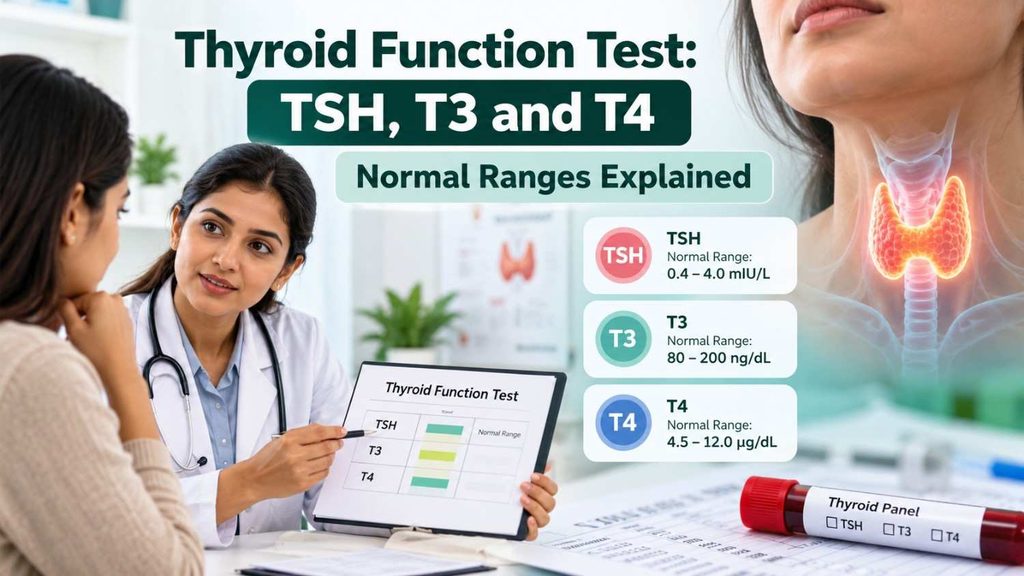
A thyroid function test is a blood test that helps doctors assess how well your thyroid gland is working. It measures hormones such as thyroid-stimulating hormone (TSH), thyroxine (T4), and triiodothyronine (T3). These hormones influence metabolism, body temperature, heart rate, energy levels, and several other essential functions.
Understanding your thyroid function test results can help you know whether your hormone levels fall within the laboratory’s reference range or require further evaluation. High or low results may indicate a thyroid disorder, but they do not always confirm a diagnosis on their own.
In this guide, you will learn the typical TSH, T3, and T4 normal ranges for adults, what each test measures, how to interpret common result patterns, and when to discuss your results with a healthcare professional.
What Is a Thyroid Function Test?
A thyroid function test is a blood test used to evaluate the activity of the thyroid gland. The thyroid is a small, butterfly-shaped gland located at the front of the neck. It produces hormones that help regulate how the body uses energy.
Doctors commonly use three measurements:
- TSH (thyroid-stimulating hormone): A hormone produced by the pituitary gland that signals the thyroid to produce thyroid hormones.
- T4 (thyroxine): The main hormone released by the thyroid. Much of it circulates in the blood bound to proteins, and some is converted into T3.
- T3 (triiodothyronine): A thyroid hormone that plays an important role in regulating the body’s metabolic activity.
A doctor often begins with a TSH test and orders free T4 or T3 when needed. The exact combination depends on your symptoms, medical history, previous results, and the reason for testing.
TSH, T3 and T4 Normal Ranges for Adults
The following table gives examples of commonly used adult reference ranges. They are guidelines rather than universal cut-offs. Different laboratories may use different testing methods, units, and reference intervals.
| Thyroid test | Example adult reference range | What it measures |
|---|---|---|
| TSH | 0.4–4.0 mIU/L | Pituitary signal that regulates thyroid hormone production |
| Free T4 (FT4) | 0.8–1.8 ng/dL | T4 that is not bound to blood proteins |
| Total T4 | 5–12 µg/dL | Both protein-bound and unbound T4 |
| Total T3 | 80–200 ng/dL | Protein-bound and unbound T3 |
| Free T3 (FT3) | 2.3–4.2 pg/mL | T3 that is not bound to blood proteins |
These are illustrative ranges, not the correct reference intervals for every laboratory. Your report may show different values, and the reference range printed on your own report should be used when interpreting your results.
Pregnancy, age, certain medicines, other illnesses, and changes in thyroid-binding proteins can affect thyroid test results. Children and pregnant people may require different reference ranges.
1. TSH Test: Normal Range and Meaning
TSH stands for thyroid-stimulating hormone. It is produced by the pituitary gland in the brain and helps regulate how much thyroid hormone the thyroid gland releases.
Because the pituitary responds to changes in thyroid hormone levels, TSH is commonly used as the initial blood test for suspected thyroid dysfunction.
What Is the Normal TSH Range?
A commonly used example of the adult TSH reference range is approximately 0.4–4.0 mIU/L. However, some laboratories use a slightly different upper or lower limit.
Your result should be compared with the reference interval provided by the laboratory that performed the test.
What Does a High TSH Level Mean?
A TSH level above the laboratory’s reference range may indicate that the thyroid is not producing enough hormone.
In primary hypothyroidism, the pituitary releases more TSH in an attempt to stimulate the thyroid gland.
A high TSH result does not automatically mean you need medication. Your free T4 level, symptoms, medical history, and whether the abnormality persists help determine the next step.
What Does a Low TSH Level Mean?
A low TSH level can indicate that the body is receiving too much thyroid hormone, as may occur in hyperthyroidism.
However, low TSH can also occur because of certain medicines, pregnancy-related changes, serious illness, or problems involving the pituitary gland.
Doctors usually assess free T4 and sometimes T3 to understand what a low TSH result means.
2. T4 Test: Normal Range and Meaning
T4, also called thyroxine, is the main hormone produced by the thyroid gland. It circulates through the bloodstream and can be converted into T3 in various tissues.
There are two commonly reported forms of T4: total T4 and free T4.
Free T4 (FT4)
Free T4 measures the portion of thyroxine that is not attached to blood proteins. It is often used alongside TSH to evaluate thyroid function.
An example adult free T4 reference range is approximately 0.8–1.8 ng/dL, although your laboratory may use a different range.
Total T4
Total T4 includes both protein-bound and unbound hormone. Its result can be affected by changes in thyroid-binding proteins, including those that occur during pregnancy or with certain medicines.
For this reason, doctors often interpret free T4 alongside TSH when investigating possible thyroid dysfunction.
What Do High or Low T4 Results Mean?
- High free T4: May indicate excess thyroid hormone, particularly when TSH is low.
- Low free T4 with high TSH: Commonly indicates primary hypothyroidism.
- Low free T4 with low or inappropriately normal TSH: May suggest a problem involving the pituitary gland and requires clinical evaluation.
T4 results should always be interpreted together with TSH and the broader clinical picture.
3. T3 Test: Normal Range and Meaning
T3, or triiodothyronine, is an active thyroid hormone. Although the thyroid releases some T3 directly, much of the body’s T3 is produced when tissues convert T4 into T3.
Doctors may order a T3 test when hyperthyroidism is suspected, especially if TSH is low but free T4 is not elevated.
What Is the Normal T3 Range?
Examples of adult reference ranges include:
- Total T3: Approximately 80–200 ng/dL.
- Free T3: Approximately 2.3–4.2 pg/mL.
These values vary between laboratories, so check the range and units shown on your own report.
What Does a High T3 Level Mean?
A high T3 result may occur in hyperthyroidism. In some cases, T3 is elevated even when T4 remains within its reference range. This can occur in a form of hyperthyroidism sometimes called T3 thyrotoxicosis.
Other factors, including medicines and supplements, may affect results. A doctor will consider TSH, T4, symptoms, and possible causes before reaching a conclusion.
Can T3 Be Normal in Hypothyroidism?
Yes. T3 may remain within its reference range even when someone has hypothyroidism, because the body can maintain T3 levels for a time despite changes in T4.
This means a normal T3 result alone does not rule out hypothyroidism. TSH and free T4 are generally more useful for evaluating suspected primary hypothyroidism.
How to Interpret TSH, T3 and T4 Results Together
The relationship between TSH and thyroid hormones can help doctors identify patterns that suggest an underactive or overactive thyroid.
| Common test pattern | Possible interpretation |
|---|---|
| High TSH + low free T4 | Overt primary hypothyroidism |
| High TSH + normal free T4 | Possible subclinical hypothyroidism |
| Low TSH + high free T4 and/or T3 | Overt primary hyperthyroidism |
| Low TSH + normal free T4 and T3 | Possible subclinical hyperthyroidism |
| Low free T4 + low or inappropriately normal TSH | Possible central hypothyroidism |
These patterns are not a substitute for diagnosis. Results can be affected by pregnancy, medicines, acute illness, laboratory variation, and pituitary disorders. Some situations require repeat testing or additional investigations.
Example 1: High TSH and Low Free T4
Suppose a person’s TSH is above the laboratory’s reference range and their free T4 is below it. This pattern commonly suggests primary hypothyroidism, meaning the thyroid gland is not producing enough hormone.
A doctor may investigate the cause, review symptoms and medicines, and determine whether treatment is appropriate.
Example 2: Low TSH and High Free T4
When TSH is low and free T4 is elevated, the pattern may indicate hyperthyroidism. A clinician may request T3 testing and additional tests to identify the cause, such as Graves’ disease or overactive thyroid nodules.
Example 3: Abnormal TSH but Normal Free T4
A TSH result outside the reference range with a normal free T4 may indicate subclinical thyroid dysfunction. This does not automatically require medication.
The appropriate response depends on how abnormal the result is, whether it persists, your symptoms, age, pregnancy status, and other health considerations.
What Can Affect Thyroid Function Test Results?
Not every abnormal thyroid result is caused by a lasting thyroid disorder. Several factors can influence test measurements.
Pregnancy
Pregnancy changes thyroid hormone requirements and the proteins that carry thyroid hormones in the blood. Pregnancy-specific reference ranges may be needed, and results should be interpreted by a clinician familiar with thyroid testing during pregnancy.
Medicines and Supplements
Certain medicines can affect thyroid function or test results. Biotin, a supplement found in some hair, skin, and nail products, can interfere with some laboratory assays and make results appear abnormal.
Tell your healthcare professional about all medicines and supplements you take. Ask whether any preparation is needed before testing; do not stop prescribed medicines on your own.
Recent Illness
Serious or acute illness can temporarily affect thyroid hormone measurements. Depending on the circumstances, a doctor may recommend repeating tests after recovery.
Laboratory Differences
Different laboratories may use different testing methods, units, and reference intervals. When comparing results from different dates, check whether the same laboratory and units were used.
Do You Need to Fast Before a Thyroid Function Test?
Fasting is not usually required for a routine TSH, T3, or T4 blood test. However, your doctor or laboratory may give specific instructions if other blood tests are being performed at the same time.
Follow the instructions provided by the testing facility. If you take thyroid medication or supplements, ask your clinician whether the timing of your dose or any supplement could affect your testing plan.
When Should You Get a Thyroid Function Test?
A doctor may recommend thyroid testing if you have persistent symptoms that could be related to thyroid dysfunction, such as:
- Unexplained weight gain or weight loss
- Ongoing tiredness or unusual changes in energy
- Feeling unusually cold or hot
- A rapid or irregular heartbeat
- Persistent constipation or frequent bowel movements
- Menstrual changes or fertility concerns
- Swelling at the front of the neck
- Monitoring needs related to an existing thyroid condition or its treatment
These symptoms can have many causes. A thyroid function test can help investigate a possible thyroid problem, but it does not replace a full medical assessment.
Seek urgent medical attention for chest pain, fainting, severe breathlessness, or a very rapid heartbeat accompanied by severe illness.
Frequently Asked Questions
1. What is the normal TSH level for adults?
A commonly used example adult TSH range is 0.4–4.0 mIU/L. The appropriate range can differ by laboratory, age, pregnancy status, and clinical circumstances. Use the reference interval on your report.
2. Which thyroid test is most important: TSH, T3, or T4?
TSH is often the first test used to assess thyroid function. Free T4 helps clarify abnormal TSH results, while T3 is particularly useful in selected cases where hyperthyroidism is suspected.
3. Can a thyroid function test detect both hypothyroidism and hyperthyroidism?
Yes. TSH, free T4, and sometimes T3 can help identify patterns consistent with an underactive or overactive thyroid. Additional tests may be needed to determine the underlying cause.
4. Does a normal TSH mean my thyroid is healthy?
A normal TSH often suggests normal thyroid function in otherwise healthy adults. However, it may not tell the whole story in certain situations, including suspected pituitary disorders or some complex medical circumstances. A clinician interprets the result in context.
5. Is a high TSH level dangerous?
A high TSH result can indicate hypothyroidism, but its significance depends on the level, free T4, symptoms, and other factors. Some mild abnormalities may be monitored, while others require treatment.
6. Can I interpret my thyroid report without seeing a doctor?
You can learn what the terms and reference ranges mean, but you should not diagnose or treat a thyroid disorder from the report alone. A healthcare professional can interpret your results alongside your medical history and symptoms.
7. How often should thyroid function tests be repeated?
The timing depends on why you were tested, whether a thyroid disorder has been diagnosed, and whether medication has recently been started or adjusted. Your clinician will recommend an appropriate monitoring schedule.
Explore More Diabetes and Endocrine Health Topics
Thyroid function is one part of endocrine health, which covers hormones and the glands that produce them. Visit the Diabetes endocrine section on Ghaziabad Clinic for more educational information about thyroid conditions, diabetes, blood sugar management, and other hormone-related health topics.
Explore the category: https://ghaziabadclinic.com/diabetes-endocrine/
