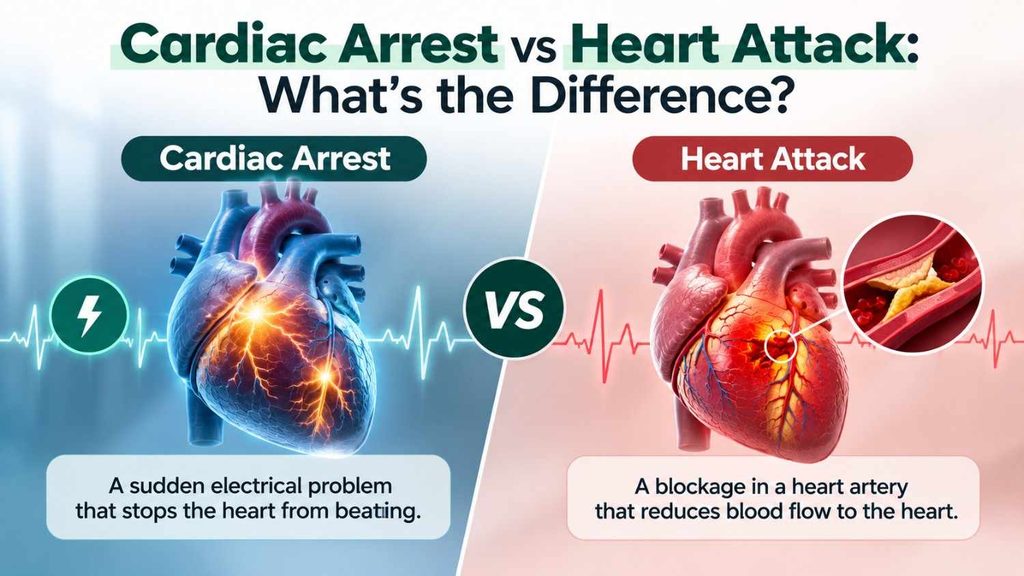
Cardiac arrest and heart attack are two serious medical emergencies that people often confuse. Although both involve the heart and can be life-threatening, they are not the same condition. Understanding the difference between cardiac arrest vs heart attack can help you recognize warning signs and respond appropriately in an emergency.
A heart attack occurs when blood flow to part of the heart muscle is blocked or severely reduced. Cardiac arrest occurs when the heart suddenly stops pumping blood effectively, usually because of a dangerous electrical disturbance.
A heart attack can sometimes trigger cardiac arrest, but not every heart attack leads to cardiac arrest. Both conditions require immediate medical attention.
In this guide, we explain the differences between their symptoms, causes, diagnosis, treatment, and emergency response. You can also explore our heart disease guide to learn more about cardiovascular conditions.
Cardiac Arrest vs Heart Attack: Key Differences at a Glance
| Feature | Heart Attack | Cardiac Arrest |
|---|---|---|
| Main problem | Blood flow to the heart muscle is blocked or severely reduced | The heart suddenly stops pumping blood effectively |
| Type of problem | Primarily a circulation problem | Usually an electrical problem |
| What happens | Part of the heart muscle may become damaged due to lack of oxygen | Blood flow to the brain and other organs suddenly stops |
| Common warning signs | Chest discomfort, shortness of breath, sweating, nausea, or unusual fatigue | Sudden collapse, unresponsiveness, and absent or abnormal breathing |
| Consciousness | The person often remains conscious initially | The person usually becomes unresponsive within seconds |
| Immediate response | Call emergency services and obtain urgent medical care | Call emergency services, begin CPR, and use an AED as soon as possible |
| Relationship | May trigger cardiac arrest | May occur as a complication of a heart attack or another condition |
These are typical patterns, not rules that apply to every person. Heart attack symptoms can be mild or unusual, and cardiac arrest may occur without obvious warning.
What Is a Heart Attack?
A heart attack, medically known as a myocardial infarction, occurs when blood supply to part of the heart muscle becomes blocked or severely reduced. The heart muscle needs a continuous supply of oxygen-rich blood to function properly.
A common cause is coronary artery disease, in which fatty deposits called plaque accumulate inside the arteries supplying the heart. If plaque ruptures, a blood clot may form and restrict blood flow.
Without prompt treatment, the affected heart muscle can become damaged or die. The sooner blood flow is restored, when possible, the more heart muscle may be saved.
Common Symptoms of a Heart Attack
Heart attack symptoms vary from person to person. They may develop suddenly or begin gradually and persist or recur.
Possible symptoms include:
- Chest discomfort: Pressure, squeezing, tightness, heaviness, or pain in the centre or left side of the chest.
- Pain in other areas: Discomfort may spread to one or both arms, the shoulders, back, neck, jaw, or upper abdomen.
- Shortness of breath: Difficulty breathing may occur with or without chest discomfort.
- Cold sweating: Unexpected sweating can accompany other symptoms.
- Nausea or vomiting: Some people experience stomach discomfort or indigestion-like symptoms.
- Dizziness or lightheadedness: A person may feel faint or unusually weak.
- Unusual fatigue: Some people experience unexplained tiredness, sometimes before more recognizable symptoms.
Women, older adults, and people with diabetes may experience less typical symptoms. However, anyone can have a heart attack with subtle or unusual warning signs.
Important: Do not wait for severe chest pain before seeking help. If you suspect a heart attack, call emergency services immediately.
What Causes a Heart Attack?
The most common cause is reduced or blocked blood flow through a coronary artery. Contributing conditions and circumstances include:
- Coronary artery disease and plaque buildup
- Formation of a blood clot inside a coronary artery
- Coronary artery spasm
- Certain less common conditions affecting the coronary artery wall
Risk factors include smoking, high blood pressure, high LDL cholesterol, diabetes, physical inactivity, and a family history of cardiovascular disease.
Read more about coronary artery disease to understand how narrowed or blocked arteries affect the heart.
What Is Cardiac Arrest?
Cardiac arrest occurs when the heart suddenly stops pumping blood effectively. It is commonly caused by a dangerous abnormal heart rhythm that disrupts the heart’s electrical activity.
When the heart cannot pump blood, oxygen delivery to the brain and other vital organs rapidly falls. The person can lose consciousness within seconds, and death can occur within minutes without treatment.
Cardiac arrest is a medical emergency that requires an immediate response. CPR helps maintain some blood flow to vital organs, while an automated external defibrillator (AED) may deliver a shock to treat certain life-threatening rhythms.
Common Symptoms and Warning Signs of Cardiac Arrest
Cardiac arrest often happens suddenly. The most important signs are:
- Sudden collapse: The person falls or loses consciousness unexpectedly.
- Unresponsiveness: They do not respond when spoken to loudly or tapped on the shoulders.
- Absent or abnormal breathing: They are not breathing normally or are only gasping.
- Loss of effective circulation: The heart is no longer pumping enough blood to support the body.
Gasping or occasional abnormal breaths should not be mistaken for normal breathing. A layperson should not delay CPR to check for a pulse.
Some people experience warning symptoms, such as chest discomfort, palpitations, shortness of breath, or dizziness, before cardiac arrest. Others have no obvious warning.
What Causes Cardiac Arrest?
Cardiac arrest is often caused by an electrical disturbance in the heart. Examples include ventricular fibrillation and certain forms of ventricular tachycardia, which can prevent the heart from pumping blood effectively.
Other possible causes or contributing conditions include:
- A heart attack or coronary artery disease
- Cardiomyopathy, a disease of the heart muscle
- Certain inherited electrical disorders
- Some serious structural heart conditions
- Severe oxygen deprivation or other critical medical emergencies
- Certain drug effects or electrolyte abnormalities
Cardiac arrest can occur in people with known heart disease and in people who have not previously been diagnosed with a heart condition.
Learn more about heart arrhythmia to understand how abnormal electrical signals can affect the heartbeat.
Can a Heart Attack Cause Cardiac Arrest?
Yes. A heart attack can trigger cardiac arrest, but the two conditions are not interchangeable.
During a heart attack, damaged or oxygen-deprived heart muscle may disrupt the heart’s electrical activity. This can cause a dangerous rhythm that prevents effective pumping and leads to cardiac arrest.
However, many heart attacks do not immediately cause cardiac arrest. Cardiac arrest can also occur because of other heart conditions or non-cardiac emergencies.
The key distinction is:
- Heart attack: Blood flow to heart muscle is interrupted.
- Cardiac arrest: The heart stops pumping blood effectively.
A person experiencing a heart attack may still be awake and breathing. A person in cardiac arrest is typically unresponsive and not breathing normally.
Both situations require emergency medical care, but the immediate actions differ.
Cardiac Arrest vs Heart Attack: How Is Treatment Different?
Treatment depends on the condition, its cause, and the person’s clinical situation.
Heart Attack Treatment
The priority is to restore blood flow to the affected heart muscle as quickly as possible and limit damage.
Treatment may include:
- Emergency assessment: Medical professionals evaluate symptoms, perform an ECG, and order blood tests such as cardiac troponin.
- Coronary angiography: This procedure can help identify blocked or narrowed coronary arteries.
- Angioplasty and stenting: A catheter-based procedure may reopen a blocked artery and place a stent to help keep it open.
- Medication: Depending on the diagnosis, medicines may be used to reduce clotting, manage cholesterol, control blood pressure, or support heart function.
- Coronary artery bypass surgery: Some people need surgery to create alternative routes for blood to reach the heart muscle.
The exact treatment depends on the type of heart attack and how urgently blood flow needs to be restored.
Cardiac Arrest Treatment
Cardiac arrest requires immediate resuscitation because the brain and other organs are deprived of adequate blood flow.
The emergency response may include:
- Calling emergency services: Request an ambulance immediately.
- Starting CPR: Begin chest compressions promptly if the person is unresponsive and not breathing normally.
- Using an AED: Apply an automated external defibrillator as soon as one is available and follow its spoken instructions.
- Advanced life support: Emergency professionals may provide defibrillation, medicines, airway support, and treatment of reversible causes.
- Hospital care after resuscitation: Survivors may need intensive monitoring, tests to determine the cause, and treatment for the underlying condition.
Not every cardiac arrest rhythm responds to a shock, which is why CPR and professional resuscitation are essential.
What Should You Do During a Heart Attack?
If you suspect that you or someone else is having a heart attack:
- Call your local emergency number immediately. In India, you can call 112 for emergency assistance; ambulance access may also be available through local services.
- Stop physical activity and rest while waiting for help.
- Follow the emergency dispatcher’s instructions.
- Do not drive yourself to the hospital if emergency medical transport is available.
- Do not delay seeking help to try home remedies or wait for symptoms to disappear.
If the person becomes unresponsive and is not breathing normally, treat the situation as possible cardiac arrest and begin CPR.
What Should You Do During Cardiac Arrest?
If a person suddenly collapses and is unresponsive and not breathing normally, act immediately.
Step 1: Check Responsiveness and Breathing
Make sure the scene is safe. Tap the person’s shoulders and shout to see whether they respond. Check whether they are breathing normally. Do not spend time looking for a pulse if you are not trained to do so.
Step 2: Call Emergency Services
Call 112 in India or your local emergency number. Put the phone on speaker if possible so the dispatcher can guide you. Ask someone nearby to bring an AED if one is available.
Step 3: Start CPR
For an adult who is unresponsive and not breathing normally, begin chest compressions in the centre of the chest.
For hands-only CPR in an adult:
- Push hard and fast at a rate of 100–120 compressions per minute.
- Aim for a compression depth of about 5–6 cm in an average adult.
- Allow the chest to return fully between compressions.
- Minimize interruptions.
If you are trained and able to give rescue breaths, follow the appropriate CPR protocol. If you are untrained, hands-only CPR is preferable to doing nothing while emergency help is on the way.
Step 4: Use an AED
If an AED is available, switch it on, attach the pads as shown, and follow its instructions. Make sure nobody touches the person when the device is analysing the rhythm or delivering a shock.
Continue CPR as directed until the person shows signs of life, emergency professionals take over, or you are unable to continue.
Never delay emergency help while trying to determine whether the person is having a heart attack or cardiac arrest.
How Are Heart Attack and Cardiac Arrest Diagnosed?
Doctors use different assessments depending on the suspected condition.
Heart Attack Diagnosis
Common investigations include:
- Electrocardiogram (ECG): Records the heart’s electrical activity and can identify changes that suggest a heart attack.
- Cardiac troponin blood tests: Detect heart muscle injury. Results are interpreted alongside symptoms, timing, ECG findings, and other clinical information.
- Coronary angiography: Helps identify the location and severity of coronary artery blockages when indicated.
- Echocardiogram: Uses ultrasound to assess heart structure, pumping function, and possible complications.
An initial normal ECG does not always exclude a heart attack. Additional tests and repeat assessments may be needed.
For more information, see our guide to the ECG test and learn about the echocardiogram.
Cardiac Arrest Diagnosis
Cardiac arrest is recognized first by the person’s sudden collapse, unresponsiveness, and absent or abnormal breathing. Treatment should begin immediately rather than waiting for diagnostic tests.
Emergency professionals use heart-rhythm monitoring to identify the rhythm and determine whether defibrillation is indicated. After circulation is restored, further tests may help identify the cause, assess organ injury, and guide treatment.
Can Cardiac Arrest and Heart Attack Be Prevented?
Not every case can be prevented, but managing cardiovascular risk factors can lower the likelihood of many heart-related emergencies.
Helpful steps include:
- Monitoring and treating high blood pressure.
- Managing cholesterol and diabetes.
- Avoiding tobacco and second-hand smoke.
- Eating a balanced diet and staying physically active.
- Taking prescribed medicines as directed.
- Seeking medical advice about unexplained chest discomfort, fainting, or palpitations.
- Discussing family history or known inherited heart conditions with a healthcare professional.
People who have already had a heart attack or have a diagnosed heart condition may need a personalized prevention plan, cardiac rehabilitation, or further evaluation.
Explore our heart disease guide for more information about common heart conditions and cardiovascular care.
Frequently Asked Questions
1. Is cardiac arrest the same as a heart attack?
No. A heart attack occurs when blood flow to part of the heart muscle is blocked or severely reduced. Cardiac arrest occurs when the heart suddenly stops pumping blood effectively, commonly because of an electrical disturbance. A heart attack can sometimes trigger cardiac arrest.
2. Which is more dangerous, cardiac arrest or a heart attack?
Both are life-threatening emergencies. Cardiac arrest causes blood circulation to fail suddenly and can lead to death within minutes without resuscitation. A heart attack can damage heart muscle and may become fatal or trigger cardiac arrest. Both require immediate emergency care.
3. Can a person be conscious during a heart attack?
Yes. Many people remain conscious during a heart attack, although they may have chest discomfort, shortness of breath, sweating, nausea, or other symptoms. A heart attack can also cause cardiac arrest, resulting in sudden loss of consciousness.
4. Can cardiac arrest happen without warning?
Yes. Cardiac arrest may occur suddenly, even in someone without a known heart condition. Some people experience warning symptoms, but others do not.
5. Can a person survive cardiac arrest?
Yes. Survival is possible, particularly when CPR begins promptly and an AED or professional defibrillation is provided when indicated. Outcomes depend on factors such as the cause, rhythm, response time, and quality of resuscitation.
6. Does every heart attack lead to cardiac arrest?
No. Many people experience a heart attack without developing cardiac arrest. However, a heart attack can trigger a dangerous heart rhythm, which is one reason rapid treatment is essential.
7. What is the first thing to do if someone collapses suddenly?
If the person is unresponsive and not breathing normally, call emergency services, ask someone to get an AED, and begin CPR. Follow the dispatcher’s instructions and use the AED as soon as it is available.
8. Can a heart attack occur without chest pain?
Yes. Some people experience shortness of breath, nausea, unusual fatigue, back or jaw discomfort, or other less typical symptoms. Symptoms vary, so seek emergency help if a heart attack is suspected.
Conclusion
The difference between cardiac arrest and heart attack comes down to what goes wrong first. A heart attack is primarily a problem with blood flow to the heart muscle, while cardiac arrest is a sudden failure of effective heart pumping, often due to an electrical disturbance.
A heart attack can lead to cardiac arrest, but the conditions are not the same. Recognizing the warning signs and responding quickly can make a critical difference.
If you suspect a heart attack, seek emergency medical care immediately. If someone collapses, is unresponsive, and is not breathing normally, call emergency services, begin CPR, and use an AED as soon as possible.
For more information about heart conditions, symptoms, and available care, visit Ghaziabad Clinic’s Heart Disease page.