
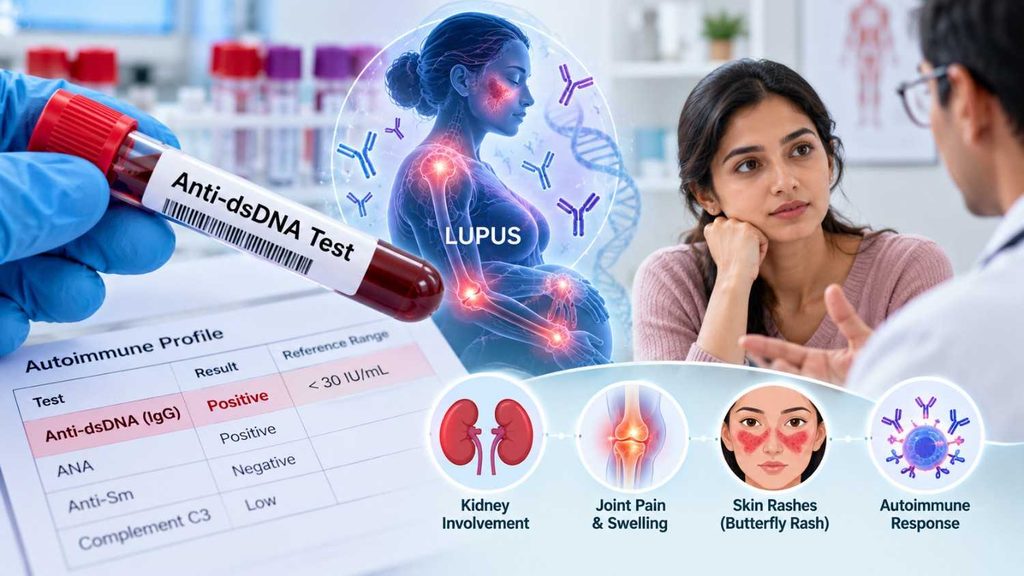
The anti-dsDNA test is a blood test that helps doctors investigate systemic lupus erythematosus (SLE), commonly known as lupus. It detects antibodies directed against double-stranded DNA, a component of the body’s genetic material.
If your doctor has recommended this test, or your report shows a positive or high anti-dsDNA result, you may wonder whether it means you have lupus. The result can provide important diagnostic information, but it must be interpreted alongside your symptoms, medical history, and other laboratory findings.
This guide explains what the anti-dsDNA blood test checks, why it is performed, how results are interpreted, and when further medical assessment may be needed.
What Is an Anti-dsDNA Test?
The anti-dsDNA test measures antibodies against double-stranded DNA (dsDNA). These antibodies are a type of autoantibody, meaning they react against components of the body’s own cells.
The test is particularly useful when a healthcare professional suspects lupus. Anti-dsDNA antibodies are more closely associated with lupus than many other autoantibodies, although not every person with lupus has them.
The test may help doctors:
- Investigate suspected lupus.
- Support a diagnosis when symptoms and other findings are consistent with SLE.
- Assess possible lupus-related kidney involvement.
- Monitor disease activity in selected people who have already been diagnosed with lupus.
Important: An anti-dsDNA result alone cannot confirm or exclude lupus. Diagnosis requires an overall clinical assessment.
Why Is the Anti-dsDNA Test Ordered?
A doctor may request an anti-dsDNA test when symptoms, examination findings, or earlier blood tests raise concern about lupus.
Symptoms that may lead to further investigation include:
- Persistent joint pain, stiffness, or swelling.
- Unexplained fatigue or fever.
- Skin rashes, including rashes that worsen after sunlight exposure.
- Mouth or nose ulcers.
- Chest pain associated with inflammation around the lungs or heart.
- Abnormal urine findings or signs of possible kidney involvement.
- An abnormal antinuclear antibody (ANA) test alongside relevant clinical findings.
These symptoms can have several causes. Having them does not automatically mean you have lupus.
What Is the Difference Between ANA and Anti-dsDNA Tests?
Both tests look for antibodies associated with autoimmune conditions, but they have different roles.
| Feature | ANA test | Anti-dsDNA test |
|---|---|---|
| Full name | Antinuclear antibody test | Anti-double-stranded DNA antibody test |
| Main purpose | Helps screen for or investigate suspected connective tissue autoimmune disease | Provides more specific evidence when lupus is suspected |
| Relationship to lupus | Commonly positive in people with lupus, but can also be positive in healthy people and other conditions | More closely associated with lupus, particularly when results and symptoms fit |
| Can it diagnose lupus alone? | No | No |
| Can a negative result rule out lupus? | A negative ANA makes lupus less likely in many situations but is not an absolute rule | A negative anti-dsDNA result does not rule out lupus |
Doctors may order anti-dsDNA testing after an ANA result or when the overall clinical picture suggests lupus. The appropriate testing sequence depends on the individual situation.
What Does a Positive Anti-dsDNA Test Mean?
A positive anti-dsDNA result means that the laboratory detected antibodies against double-stranded DNA according to its testing method and reference criteria.
When a person has symptoms and other findings consistent with lupus, a positive anti-dsDNA result can strengthen the evidence supporting that diagnosis.
However, a positive result does not automatically confirm lupus in every situation. Interpretation may depend on the antibody level, the laboratory method, other blood tests, and the person’s symptoms.
A clinician may consider additional investigations, including:
- ANA testing and other lupus-associated antibodies.
- Complement proteins C3 and C4.
- Complete blood count.
- Kidney function tests.
- Urinalysis and urine protein measurements.
- Other investigations based on the symptoms and suspected organ involvement.
Weak-positive results may be less informative than stronger results, depending on the assay used. In some cases, a doctor may recommend confirmation using another testing method.
Does a positive anti-dsDNA result mean lupus is active?
Not necessarily. Anti-dsDNA levels can be associated with lupus activity in some people, and increasing levels may sometimes occur alongside a flare, particularly when kidney involvement is a concern.
However, antibody levels do not always change in parallel with symptoms. A positive result in someone with established lupus does not, by itself, prove that the disease is currently active or that treatment needs to change.
Doctors consider the result alongside symptoms, examination findings, complement levels, urine tests, kidney function, and other relevant information.
What Does a Negative Anti-dsDNA Test Mean?
A negative result means the test did not detect anti-dsDNA antibodies at the laboratory’s reporting threshold.
This may make lupus less likely in some clinical situations, but it does not rule out the condition. Some people with lupus never test positive for anti-dsDNA antibodies, and results can vary according to the testing method and clinical circumstances.
If symptoms or other findings continue to suggest lupus, a doctor may recommend additional investigations even when the anti-dsDNA test is negative.
What Does a High Anti-dsDNA Level Mean?
A high anti-dsDNA result may provide stronger evidence of lupus when the clinical findings are consistent with the disease. In some people with established lupus, rising antibody levels may be associated with increased disease activity or lupus nephritis, which is kidney inflammation caused by lupus.
However, there is no single universal anti-dsDNA number that diagnoses lupus or measures its severity in every person.
Laboratories use different assays, units, and reference ranges. For example, one laboratory may report results in IU/mL, while another uses different units or categories.
When reviewing your report, consider:
- The laboratory’s reference range.
- Whether the result is negative, borderline, or positive according to that laboratory.
- Whether the value has changed from previous results performed using a comparable method.
- Whether you have new symptoms or changes in other test results.
Do not interpret a high result as proof of kidney damage or change your medication without medical advice.
Can the Anti-dsDNA Test Detect Lupus Nephritis?
Anti-dsDNA antibodies can be associated with lupus nephritis, a complication in which lupus affects the kidneys. The test may therefore contribute to a doctor’s assessment when kidney involvement is suspected.
However, the anti-dsDNA result cannot determine kidney health on its own.
A doctor may also assess:
- Urine protein and blood.
- Kidney function, including creatinine and estimated glomerular filtration rate (eGFR).
- Complement levels, particularly C3 and C4.
- Blood pressure and other clinical findings.
If results suggest significant kidney involvement, further evaluation by a specialist may be necessary. In selected cases, a kidney biopsy may be recommended to determine the type and severity of kidney inflammation.
Seek prompt medical advice if you notice new swelling of the legs or around the eyes, persistently foamy urine, blood in your urine, or a substantial reduction in urination. These symptoms can have several causes and require appropriate assessment.
How Is the Anti-dsDNA Blood Test Performed?
The anti-dsDNA test generally requires a blood sample collected from a vein in your arm.
The process usually involves:
- A healthcare professional cleans the collection site.
- A small needle is inserted into a vein.
- Blood is collected into a suitable sample tube.
- The sample is sent to a laboratory for analysis.
The collection usually takes only a few minutes. Mild discomfort or temporary bruising can occur at the needle site.
Do you need to fast before the test?
Fasting is generally not required for an anti-dsDNA test alone. If other tests have been ordered at the same time, however, you may need to follow different preparation instructions.
Tell your healthcare professional about your medicines and supplements, and do not stop prescribed medication unless instructed.
How long do results take?
Turnaround time varies by laboratory, testing method, and whether additional or confirmatory testing is required. Your laboratory can provide the most accurate estimate.
Can Anti-dsDNA Levels Be Used to Monitor Lupus?
Yes, in selected people with diagnosed lupus, doctors may use changes in anti-dsDNA levels as one part of ongoing monitoring.
A rise in antibody levels can sometimes accompany increased disease activity, while a decline may occur as disease activity improves. These patterns are not universal, and a change in antibody levels does not always correspond to a change in symptoms.
For meaningful comparisons, clinicians may consider whether results were measured using the same laboratory method. They also assess other markers and, importantly, how the person is doing clinically.
Anti-dsDNA levels should not be used alone to decide whether to start, stop, or adjust treatment.
When Should You Consult a Doctor?
Discuss your results with the clinician who ordered the test, particularly if your report is positive, borderline, or inconsistent with your symptoms.
A rheumatologist may be involved when lupus or another connective tissue disease is suspected. If kidney involvement is possible, your doctor may also arrange a kidney assessment or specialist referral.
Seek prompt medical assessment if you develop concerning symptoms such as new blood in your urine, marked swelling, significantly reduced urination, chest pain, or difficulty breathing.
Frequently Asked Questions
1. Is the anti-dsDNA test specific for lupus?
Anti-dsDNA antibodies are strongly associated with lupus, particularly when the result is clearly positive and the clinical findings support the diagnosis. However, the test is not perfectly specific in every assay or clinical situation, and a positive result alone is not a diagnosis.
2. Can I have lupus with a negative anti-dsDNA test?
Yes. Not everyone with lupus has detectable anti-dsDNA antibodies. A negative result does not rule out lupus when symptoms and other findings warrant further investigation.
3. What is the normal range for anti-dsDNA?
The reference range depends on the laboratory’s testing method and units. Use the reference information on your own report rather than comparing your number with a cut-off from another laboratory.
4. Does a high anti-dsDNA level always mean a lupus flare?
No. Higher or rising levels may be associated with increased activity in some people, but the result does not always reflect current disease activity. Doctors consider symptoms, complement levels, kidney function, urine findings, and other evidence.
5. Is the anti-dsDNA test the same as the ANA test?
No. ANA is a broader antibody test commonly used when investigating suspected autoimmune connective tissue disease. Anti-dsDNA measures antibodies against a specific target and can provide additional evidence when lupus is suspected.
6. Can the anti-dsDNA test detect kidney damage?
No. The test can contribute to an assessment of possible lupus-related kidney involvement, but it cannot directly determine whether kidney damage is present. Urine testing, kidney function tests, and sometimes additional investigations are needed.
7. Should I repeat the anti-dsDNA test?
Repeat testing depends on your clinical situation. Your doctor may recommend it when monitoring established lupus or clarifying an uncertain result. Repeated testing is not automatically necessary for every person with a positive result.
Conclusion
The anti-dsDNA test is an important blood test used to help investigate systemic lupus erythematosus and, in selected cases, monitor disease activity. A positive result can strengthen the evidence for lupus when symptoms and other investigations are consistent, while a negative result does not completely exclude the disease.
The most appropriate interpretation considers the laboratory’s reference range, your symptoms, other blood and urine tests, and your medical history.
For more information about related conditions, visit our Autoimmune Disease health guide.
you can also explore : Lupus Disease health guide , HIV & AIDS Disease Guide